Biological inventories and protected species in Wallonia: what the new regulations mean for your projects


Since July 1, 2026, project managers and teams conducting flora and fauna inventories of protected species in Wallonia have been operating under a new legal framework. The Decree of February 26, 2026, reformed the Nature Conservation Act (LCN) of July 12, 1973; the Walloon Government Decree (AGW) of June 11, 2026, which came into force on July 1, 2026, defines the practical procedures and repeals the 2003 decrees that previously governed exemptions. Here is what you need to know.
Why this reform?
The Nature Conservation Act of July 12, 1973, is the reference text in Wallonia for the protection of animal and plant species and nature reserves. While effective in its general principles, it was out of step with the European "Habitats" and "Birds" Directives (in terms of terminology and the conditions for granting exemptions), and its procedures were considered cumbersome by field practitioners during inventory and biological monitoring operations.
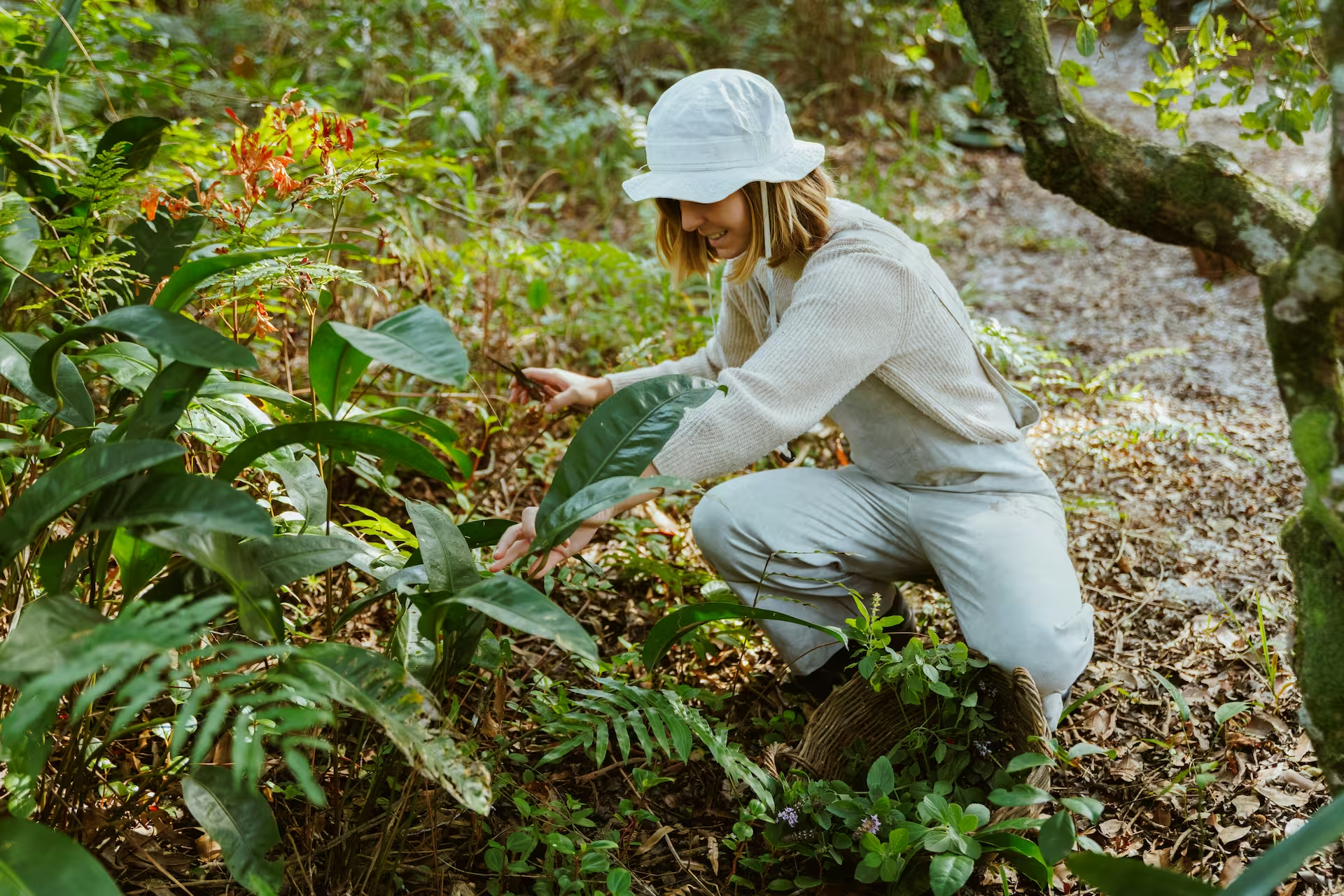
The Decree of February 26, 2026 (published in the Belgian Official Gazette on March 23, 2026, and effective as of April 2, 2026) modernized the LCN along two lines: strengthening compliance with European law and simplifying certain administrative procedures. The AGW of June 11, 2026, completes this framework by setting the forms, deadlines, and procedures applicable to notifications and exemptions since the 1st of July 2026.
A note on the spirit of the text: the announced simplification is accompanied by stricter oversight, including mandatory reporting, penalties for non-compliance, and the possibility of modifying an exemption while it is still valid.
Prior notification partially replaces the exemption
This is the most significant change for naturalist teams and project managers. In specific, well-defined cases, the formal exemption is replaced by a prior notification sent to the Department of Nature and Forests (DNF), specifically to the director of the Directorate of Nature and Green Spaces (DNEV).
Which operations are covered?
The decree covers temporary immobilization without relocation of a protected species specimen for the time required for identification, for the purposes of research, education, monitoring, or biological inventory, provided that it does not endanger the life or integrity of the specimen. The text specifies that such immobilization does not constitute capture. The collection of an aerial part of a protected plant, justified by research, education, or biological inventory purposes, also falls under this simplified regime.
The actual timeline: 30 days before, starting on day 31
The key requirement to follow: according to the AGW of June 11, 2026, the notification form must be submitted to the DNF no later than 30 days before the start of operations. In practical terms, for a notification submitted 30 days in advance:
- Day 15: The DNEV notifies any potential inadmissibility. After this period, the notification is deemed admissible.
- Day 30: The DNEV informs of the existence or absence of a risk.
- Day 31: Earliest possible start date, in the absence of a response.
The notification can cover several years
The notification can be submitted annually and cover different species and different sites. The AGW goes further: it is valid for the period it covers, with a maximum of five years from the date it is sent.
For a consultancy firm that carries out routine inventories, the goal is therefore not to notify campaign by campaign, but to build a framework notification covering the usual species, sites, and methods.
What the DNF does: assess a risk, not issue an authorization
The director of the DNEV assesses whether the operations present a risk of harm to the life or integrity of the specimens (or a risk of destruction, for botanical sampling). They inform the author within 30 days. Three outcomes are possible:
- No risk identified or no response within the deadline: the operation may be carried out without specific conditions.
- Risk identified: specific conditions are imposed to prevent it.
- Unmanageable risk: the operation shifts to the derogation regime under Articles 5 and 5bis.
There is therefore no such thing as a "refusal of notification." It is a declarative regime with positive silence: silence from the administration acts as a green light, and the most restrictive scenario is not a refusal but a shift to the derogation process, requiring the timeline to be rescheduled.
It is important to clarify what this regime does not cover. The prior notification applies to a defined scope of inventory and monitoring operations, with no impact on the conservation status of the specimens. Any other act likely to affect protected species more significantly (destruction of nests, damage to habitat, disturbance in the context of a development project) continues to require a derogation.
Obligations following notification
- Mandatory report : must be submitted to the DNEV director within 30 days of the notification's expiration. For multi-year notifications, this is required within 30 days following each 12-month period.
- On-site copy : personnel conducting operations must keep a copy of the notification and any associated conditions on-site for the entire duration of the work.
- Nature reserve : if operations take place within a nature reserve, proof of prior agreement from the site manager must be attached to the notification.
- Notification content : identity of the notifier and operators, reasons, nature and purpose of the operations, species and number of specimens (if determinable), methods, locations, and timeframe. These details are mandatory; failure to provide them will result in the notification being deemed inadmissible.
More flexible, better-regulated exemptions
For projects that genuinely impact protected species or habitats, the exemption remains the primary tool. However, the 2026 Decree introduces several changes that are beneficial for industrial and real estate project developers.
.avif)
Transfer and mandate
Exemptions can now be transferred and the beneficiary may appoint a third party to implement them: a useful flexibility for projects that change ownership or involve subcontractors. Two points must be clarified. First, the transfer is not a mere formality: it requires a formal application for approval submitted to the authority that issued the authorization, which must rule within 30 days. If no decision is made, the transfer is deemed rejected. Furthermore, until the joint notification from the transferor and the transferee has been completed, The transferor remains liable for non-compliance with the derogation and its consequences.
Content, timelines, and single procedure
The content of decisions is clarified: avoidance conditions, mitigation and compensation measures, as well as implementation and support procedures, are included in the act itself.
Processing timelines are set: the Inspector General will notify the applicant if the application is complete within 30 days. Otherwise, the application is deemed complete and admissible. The file is then decided upon within 90 days from the date the application is deemed complete, extendable by 30 days with a reasoned decision. Once this period has elapsed, the application is deemed rejected, which allows for an appeal to the minister within 30 days. In cases of duly justified urgency, these timelines are reduced to 8 and 30 days.
When an application concerns both species protection measures and those for nature reserves, it may be submitted via a joint application and be subject to a single authorization, which reduces the administrative burden. Furthermore, the administration may adapt an ongoing derogation if scientific knowledge evolves, after giving the holder the opportunity to submit their observations.
The implementation report: an obligation not to be overlooked
The beneficiary of a derogation must submit a report within 30 days of its expiration (or after each 12-month period for a multi-year derogation). Failure to submit a report triggers a series of sanctions:
- A reminder letter is sent to the holder.
- If there is no response within 30 days of the reminder: the authorization is suspended.
- If there is no response within 60 days: the authorization is withdrawn.
The most significant consequence: any new derogation application will be inadmissible as long as the report for a previous derogation has not been submitted.
What this means for your projects in practice
If your project involves flora and fauna surveys required for an environmental permit, an Environmental Impact Assessment (EIA), or an appropriate assessment of Natura 2000 impacts, your field teams must now submit a notification form to the DNF at least 30 days before starting surveys on protected species, and may begin work on the 31stday if no response is received. This step must be factored into your project schedule.
If your project is likely to have a more significant impact on protected species, a derogation remains mandatory. The application must reflect the new content requirements set by the Decree, particularly regarding avoidance and mitigation measures, as well as objective evidence demonstrating that no other satisfactory solution exists.
A note for ongoing files: notifications and derogation requests submitted before July 1st , 2026, will continue to be processed under the rules in effect at the time of their submission. The decrees of November 20, 2003 (non-bird species) and articles 2 to 14 of the decree of November 27, 2003 (birds) have been repealed: internal procedures and reference documents citing them must be updated.
In both cases, the best practice remains the same: address the issue of protected species as early as possible in the project design phase, well before submitting the permit application. A preliminary analysis of the site's ecological sensitivity helps anticipate notification or derogation requirements and prevents delays during the review process.
ABV Environment supports Walloon project developers with their flora and fauna inventories, appropriate impact assessments, and protected species derogation files. Our team of naturalists provides expertise in botany, ornithology, entomology, herpetology, and chiropterology across the entire Walloon region.
Is your project affected by protected species? Contact our team for a preliminary analysis.
Internal links
- Flora & fauna inventories and biodiversity — ABV Environment — Learn more about our biodiversity inventory and assessment services
- Appropriate impact assessment and Natura 2000 — ABV Environment — Assessing impacts on Natura 2000 sites: our approach
- Environmental Impact Assessments (EIA) in Wallonia — ABV Environment — From feasibility to permit: our environmental assessment expertise