PFAS in Belgium: the ClientEarth complaint and what it means for your business


On July 8, 2026, the NGO ClientEarth filed a formal complaint against Belgium with the European Committee of Social Rights (ECSR), citing the authorities' failure to act in the face of some of the highest PFAS contamination levels in Europe. This human rights-based approach, a first for this type of environmental case in Belgium, marks a turning point: legal pressure on the Belgian state is intensifying. For companies operating or having operated potentially contaminated sites, the signal is clear.
Belgium: The worst case of PFAS contamination in Europe
According to the Forever Pollution Project, a mapping database that tracks "forever chemicals" across Europe, Belgium has the highest levels of PFAS (per- and polyfluoroalkyl substances) on the continent. The situation affects all three regions.
In Flanders, the 3M plant in Zwijndrecht, which produced PFAS from the 1970s until 2024, is the most documented hotspot. Analyses have confirmed abnormally high concentrations in the blood of young people living within five kilometers of the site. In Wallonia, some 12,000 residents in the municipality of Chièvres consumed water contaminated with PFAS linked to a nearby airbase. In Brussels, the operator Vivaqua has been detecting TFA (trifluoroacetic acid), a persistent PFAS, in the reservoirs supplying the capital since 2021, at concentrations exceeding the future European standard.
ClientEarth's complaint is based on these documented contaminations and accuses the Belgian authorities of systematic inaction: the information had been available for years, sometimes decades, without any concrete protective measures being taken.
A human rights complaint: what exactly is it?
The European Committee of Social Rights (ECSR) is the Council of Europe's monitoring body responsible for ensuring that member states comply with the Revised European Social Charter. Its collective complaints procedure allows authorized organizations, including environmental law NGOs, to file a complaint against a state.
In case No. 266/2026, ClientEarth v. Belgium, registered on July 9, 2026, ClientEarth argues that Belgium has violatedArticle 11(1) and 11(3) of the Charter, which guarantee the right to health protection, by failing to take sufficient measures to protect the population, particularly children, who are identified as a disproportionately exposed group, from the risks associated with PFAS.
The procedure involves a response from the Belgian State, followed by a reasoned decision from the ECSR, which is then forwarded to the Committee of Ministers of the Council of Europe. If the ECSR finds a violation, the State must report on the measures taken to address it. The decision is not enforceable in the same way as a court judgment, but it generates significant political and diplomatic pressure and can catalyze accelerated legislative or regulatory reforms. This is precisely the effect ClientEarth is seeking: "We chose this path because this committee has very strong enforcement power," said Hélène Duguy, a lawyer at ClientEarth.
A tightening regulatory framework in parallel
The ClientEarth complaint is part of a broader context of tightening regulations on PFAS.
Since January 12, 2026, Belgium has transposed the new limit values imposed by the European Drinking Water Directive via royal decree: 0.10 µg/L for individual PFAS substances among the 20 priority references (PFAS-20), and 0.50 µg/L for the total sum of PFAS. These thresholds apply to tap water and, eventually, to groundwater used for human consumption.
At the European level, a proposal for a universal restriction on PFAS is currently under review as part of the REACH regulation. If adopted, this restriction would strictly regulate the residual use of PFAS in industry, including in sectors still in transition.
For companies whose activities have involved PFAS—whether through AFFF-type firefighting foams (airfields, fire stations, petrochemical sites), fluorinated coatings, or fluorinated chemical processes—the convergence of judicial and regulatory pressure is a strong signal that should not be ignored.

What this means for your business
The ClientEarth complaint does not directly target private operators, but it increases pressure on Belgian authorities to strengthen their requirements for potentially contaminated sites. Several practical questions arise immediately.
Is your site potentially affected?
Certain activities are typically associated with PFAS deposits in soil and groundwater: past use of AFFF foams, storage of fluorinated chemicals, or proximity to a former PFAS production or processing facility. If your site's history includes any of these activities, a verification is necessary.
Do you have a soil status assessment?
In the Brussels-Capital Region, the Soil Condition Assessment (SCA)may be triggered during an environmental permit renewal or site transfer. In Wallonia, a preliminary soil investigation may be required or conducted voluntarily. In Flanders, theOriënterend bodemonderzoek (OBO) plays an equivalent role. In all three cases, PFAS are now among the substances that must be included in investigation protocols and risk assessments.
Do your groundwater extractions meet the new thresholds?
The limit values in effect since January 2026 apply to drinking water, but they are increasingly serving as a benchmark for risk assessment in cases of groundwater contamination. If you extract groundwater or are developing a project on a site with an uncertain history, a preventive PFAS investigation is a top-priority precaution.
What ABV Environment can do for you
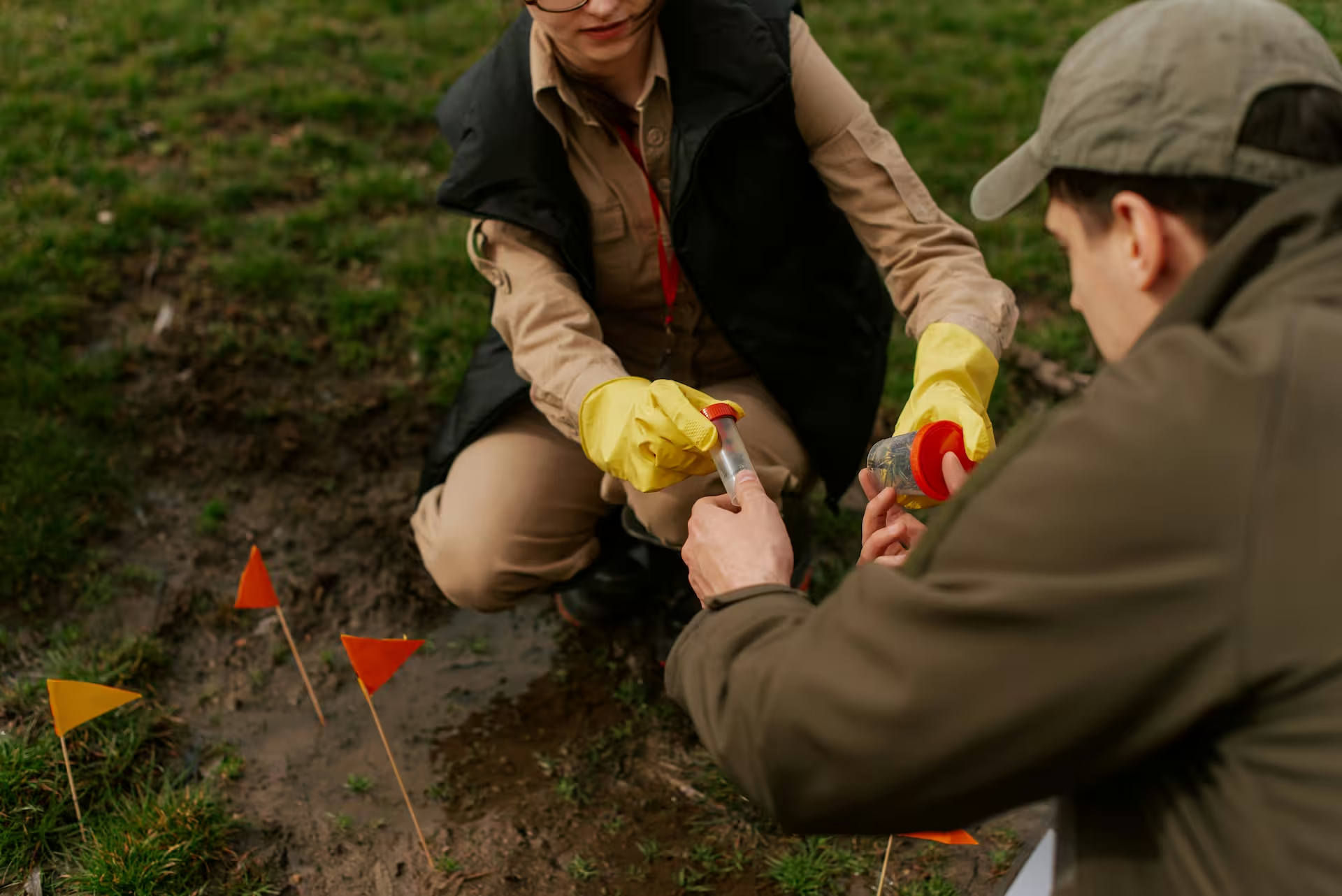
ABV Environment supports companies, developers, and project managers in managing soil and groundwater potentially contaminated with PFAS across all three Belgian regions.
Our teams are certified to conduct regulatory soil studies in each region: Soil Condition Assessment (SCA) in Brussels, preliminary and descriptive soil investigations in Wallonia, OBO and BBO in Flanders. We integrate PFAS analyses into our investigation protocols, in accordance with the current regulatory limit values.
We also intervene at an early stage with a PFAS vulnerability audit for your site: identification of potential sources, analysis of activity history, and targeted analytical screening. In the event of confirmed contamination, our teams coordinate the remediation phase and manage follow-up procedures with Brussels Environment, the SPW, and OVAM.
Is your site or project affected by PFAS? Contact our team for an initial consultation.