PFAS in Uccle: when an environmental permit reveals contamination

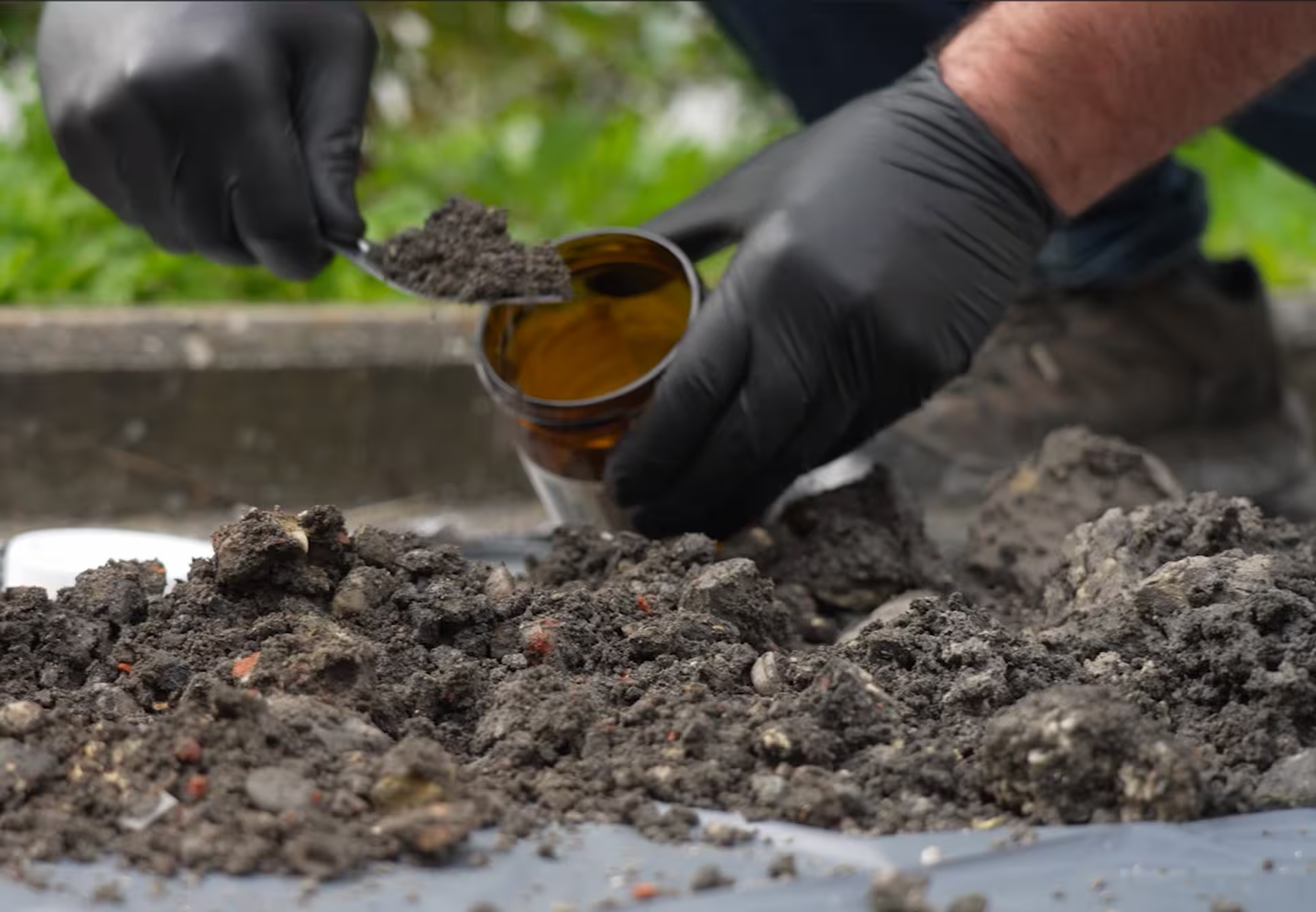
In Uccle, a Soil Condition Assessment (RES) conducted as part of an environmental permit renewal has uncovered exceptional PFAS contamination at the former site of fire extinguisher manufacturer Sicli. The Region had to step in for a bankrupt operator, and an official report of the violation has been forwarded to the public prosecutor. This case illustrates the chain of liability regarding soil management in Brussels—and what it means for operators.
Pollution revealed by a permit procedure
In 2023, the company Sicli, a fire extinguisher manufacturer located at 430 Chaussée de Neerstalle in Uccle, commissioned a Soil Condition Assessment as part of its environmental permit renewal. The results were unequivocal: 31 PFAS compounds (per- and polyfluoroalkyl substances, or "forever chemicals") were detected in the soil, with concentrations exceeding standards by up to 708 times on the industrial site. In the groundwater, 20 PFAS compounds were identified, with levels reaching 1,058 times the standard. Off-site, in the immediate vicinity, the exceedances ranged from 1.4 to 530 times the standard.
Brussels Environment became aware of these results in December 2023. In the meantime, Sicli went bankrupt. The liquidators refused to carry out the required additional studies. The Region and the municipality of Uccle had to take charge of an investigation that the operator failed to complete.
The pollution was made public jointly by Brussels Environment and the municipality in June 2025, and the detailed results were published in September 2025.
[IMAGE — location: "contamination" section] Visual description: neighborhood map or plan with a security perimeter zone delineated around an urban industrial site, neutral tones Alt text FR: 100-meter security perimeter around the former Sicli site in Uccle following PFAS contamination
The RES: a component of the environmental permit with concrete consequences
In Brussels, the Soil Condition Assessment (RES) is a mandatory document for many procedures governed by the Ordinance of March 5, 2009, regarding the management and remediation of polluted soil in the Brussels-Capital Region, administered by Brussels Environment. It is specifically required when renewing or modifying an environmental permit, when selling land with an industrial history, upon the accidental discovery of pollution, or in certain cases when applying for a planning permit.
The RES is not just an administrative form. It involves field investigations, sampling, and soil and water analysis, and can lead to follow-up obligations: Detailed Study (ED), Risk Assessment (ER), or Remediation Project (PA). The result can also be a declaration of compliance, but it is up to the investigation to demonstrate this.
Since 2022, Brussels Environment has been identifying and mapping Brussels plots contaminated with PFAS. To date, 82 plots have confirmed contamination (47 in the soil, 55 in the groundwater), and approximately 3,500 sites are listed as potentially contaminated due to activities or incidents likely to have released PFAS, particularly the use of fire-fighting foams.
When the operator disappears: the Region takes over
Sicli's bankruptcy did not end its environmental obligations. An official report of the violation was sent to the public prosecutor against the liquidators who refused to continue the additional analyses. Brussels Environment conducted the investigations itself within a 100-meter radius of the site.
Precautionary recommendations have been issued for residents within this perimeter: do not use well water, and do not consume fruit, vegetables, eggs, or small livestock from gardens located in the area. Drinking water distributed by Vivaqua is not affected.
This case illustrates a fundamental principle of Brussels environmental law: liability is attached to the site and its usage history, not just to the operator of record at the time of the permit. It can be transferred, and in the event of an operator's failure, the Region may intervene ex officio, with subsequent recourse against those responsible if necessary.

The PFAS regulatory framework is evolving rapidly
In Brussels, the standards applicable to PFAS in soil and groundwater were integrated into a decree published in the Belgian Official Gazette on July 9, 2024. For drinking water, the European standard of 100 ng/L (sum of 20 PFAS) has been in force in the Brussels-Capital Region since March 2024. A "total PFAS" standard of 500 ng/L (including TFA, trifluoroacetic acid) came into effect in all EU member states in January 2026, in accordance with Directive 2020/2184.
At the European level, Regulation (EU) 2025/1988 of October 2, 2025, adopted under the REACH regulation, prohibits the placing on the market and use of PFAS in fire-fighting foams at a concentration equal to or greater than 1 mg/L (sum of all PFAS) starting October 23, 2030. Mandatory labeling and reinforced conditions of use apply from October 23, 2026. The link to the Sicli case is direct: the company produced fire-extinguishing foams containing PFAS.
What this means for you
If you operate an industrial or commercial site in Brussels, several situations can trigger an obligation for a Soil Condition Assessment (RES) and, with it, a full investigation of the state of your soil:
- the renewal or substantial modification of your environmental permit;
- the sale or acquisition of land with an industrial or commercial history
- the accidental discovery of pollution during construction work;
- certain renovation or construction projects requiring a planning permit.
The Sicli case serves as a reminder that a lack of prior investigation offers no protection. On the contrary, it can leave the operator in a position where the authorities step in and take action at their expense.
Anticipating means choosing your own timeline and solutions. Reacting means letting the process spiral out of control.
ABV Environment conducts soil studies in the Brussels-Capital Region in accordance with the 2009 Soil Ordinance procedures: Soil Condition Survey (SCS), Detailed Study (DS), Risk Assessment (RA), and Remediation Project (RP). Our teams are accredited by Brussels Environment for these assignments. Is your site subject to a permit procedure or an industrial history involving PFAS risks? Contact our experts for an initial assessment.