Companies: why adopt a CSR approach?


Businesses: why adopt a CSR approach?
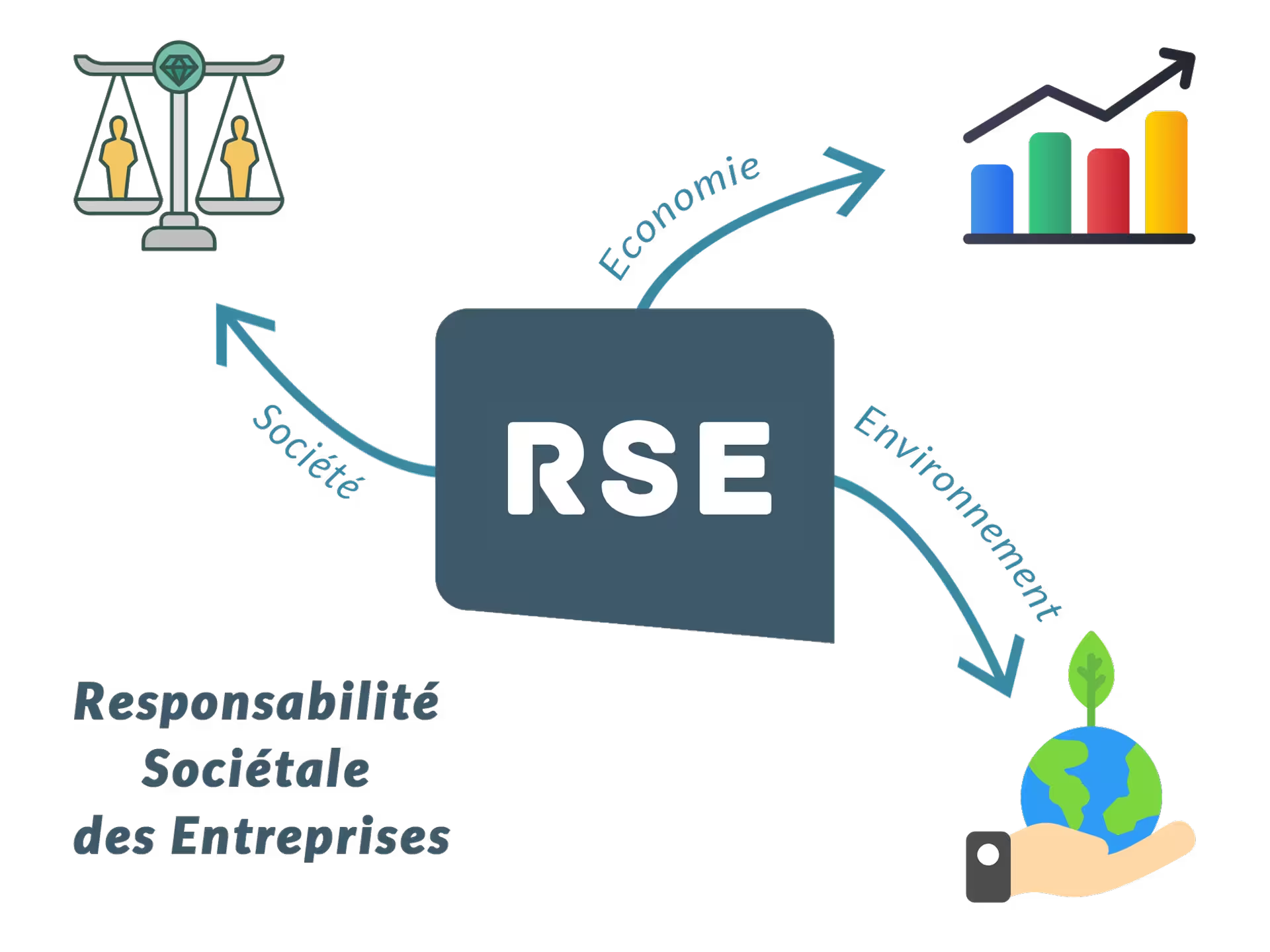
A growing number of organizations (businesses, administrations, etc.) are integrating economic, social and environmental criteria at the heart of their development model, making it part of a sustainable and sustainable approach. While the approach reflects a real desire on the part of organizations to take their responsibilities in the face of societal and environmental challenges, it also makes it possible to anticipate market developments and to ensure the sustainability of the activity.
Recognizing the societal and environmental impacts inherent in their activities, with the desire to act in a more responsible and sustainable manner, organizations intend to play a major role in the transition to be carried out in favor of sustainable development.
A desire to act in a responsible and sustainable manner
“While the theme of Corporate Social Responsibility (CSR) is not new, over the past five years there has been a significant change in the attitude of managers towards these issues.“Explain Yannick Masquelier, Founding Partner of ABV Development, Consulting firm specialized in the environmental sector.
“This reflects an evolution in the approach of managers. Yesterday, the only factor in an organization's performance was financial results. Now, there is a real desire to consider the “sustainable” value of the organization, a societal and environmental value.”
From CSR to taxonomy
If companies are increasingly taking ownership of this subject, it is also to better anticipate the new obligations and constraints to come. The European Union, in fact, is currently implementing a major project, one of the key elements of which lies in the adoption of a” green taxonomy ”.
The green taxonomy is a system for classifying economic activities to identify those that are environmentally sustainable, that is, that do not worsen climate change.
The taxonomy aims to guide and mobilize private investments to achieve climate neutrality in the next 30 years, thus fully in line with the climate and environmental goals of the” Green Deal ” European.
” The desire is therefore to facilitate the financing of organizations that are part of a sustainable approach and activities in line with societal and environmental commitments. ”, specifies Yannick Masquelier.
While this taxonomy is still only partially implemented (with mandatory reporting deadlines for certain types of companies between 2022 and 2026), financial and public actors are increasingly integrating these sustainability aspects into their call for tenders or even into the criteria for eligibility for funding.

Adopting a sustainable approach, a decisive challenge for the future of businesses
“While these criteria are not yet decisive for accessing a public contract, we can see that this dimension is gaining in importance.”, adds Yannick Masquelier. “There are and will be more and more requirements and expectations for economic organizations to report on their environmental and societal performance related to their activity, but also on their entire value chain. Also, if these organizations are forced to make commitments in this area, they will require their partners to do the same. In many cases, the pressure for respectful development will come from customers, who also want to turn to more responsible actors. In the end, all actors are and will be concerned.“
In other words, if players want to maintain their position at the heart of the market, maintain the links they maintain with their customers, they will have no other choice: they will have to adopt a sustainable development model.
ISO 26000, ODD, ESG: adopting a sustainable model methodically
” However, adopting a sustainable model is not so easy. This means preparing and acting methodically. ”, continues Yannick Masquelier.
For several years, ABV Development consolidates solid expertise around these challenges, supporting companies in their transition and the adoption of a responsible approach.
“The challenge is to manage to integrate these environmental, societal and good governance criteria at the organizational level.. To do this, we rely in particular on standards or normative frameworks, such as ISO 26000 (RSE), which defines how organizations can and should contribute to sustainable development. This approach is said to be “qualitative and engaging” towards the stakeholders/interested parties of organizations.”
“In addition, our approach is also based on ESG (Environmental, Social and Governance), which is called “quantitative” and allows companies to limit their environmental, social and economic impacts. In addition to this, we use the 17 Sustainable Development Goals (SDGs) approach to provide an ongoing assessment of the organization's sustainability efforts. These focus on the preservation of water, the limitation of climate impacts and carbon neutrality, or access to education, established by the United Nations and adopted since 2015.“
CSR, a continuous improvement process
The process starts with an inventory carried out at the organizational level. This allows you to define how the company creates value at the level economic, societal and environmental.
“This includes ensuring that future developments do not contravene defined sustainable development goals and seeing how the activity can contribute to them. “Precise Yannick Masquelier. “Based on the current situation, we will identify with managers the areas for improvement to be explored at the organizational and operational levels or even through the adaptation of the business model, to minimize impacts and, ideally, consider a more virtuous approach.“
Evaluate your performance to stand out
These efforts” CSR ” are part of a well-defined framework, with evaluation criteria to be implemented to report on impacts. The approach, if carried out well, can contribute to the improvement of the company's performance both economically and socially or environmentally, especially if it can report on the results obtained as a result of the efforts made. With this in mind, ABV Development works with various certification platforms to assess the commitment of organizations to the CSR approach and enable them to better position themselves and stand out.