Soil drought in Belgium: eleven times more likely. What the summer of 2026 means for your sites and projects

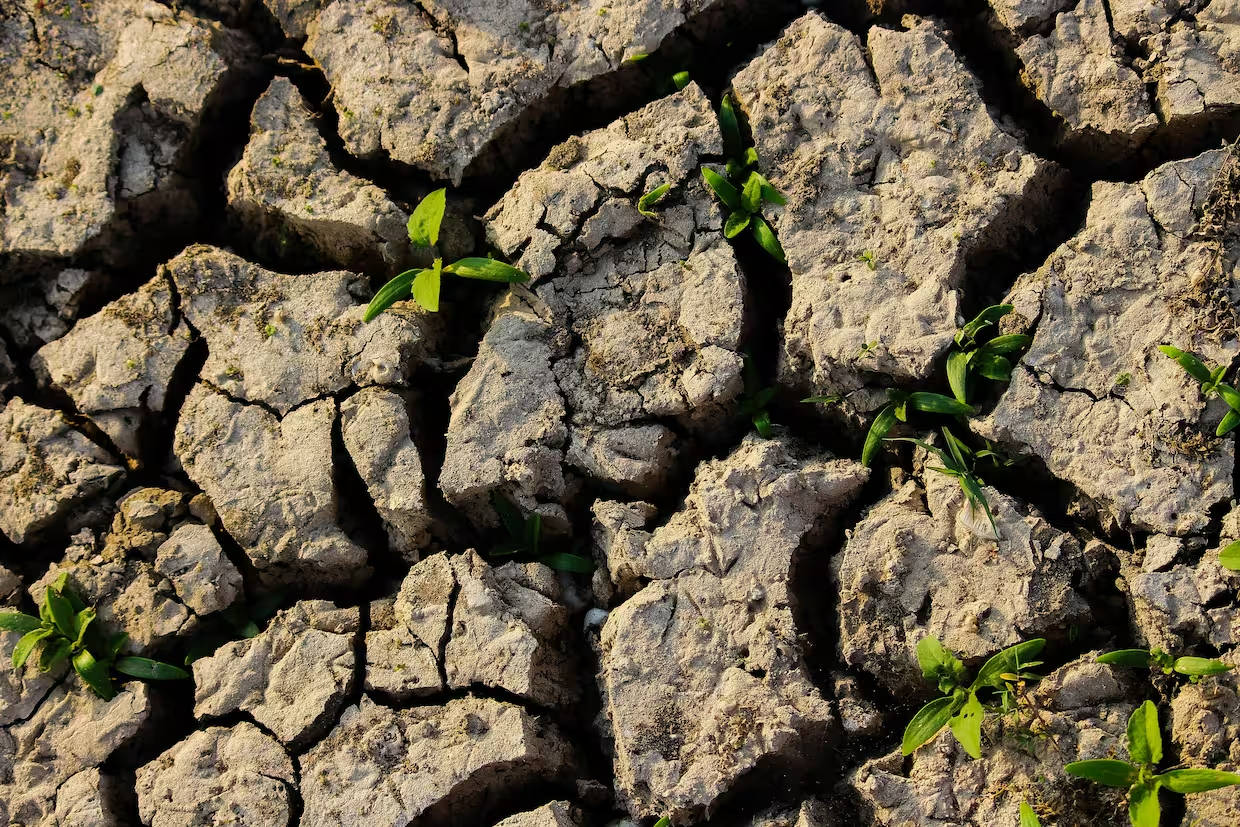
On July 23, 2026, the World Weather Attribution (WWA) scientific network published a study quantifying the link between climate change and soil drought in Belgium: the probability of such a drought has increased elevenfold due to human-induced global warming. For companies, industrial players, and developers managing sites or projects in Belgium, this figure is more than just a headline. It is a management signal that must be integrated today.
What the WWA study of July 23, 2026, says
The World Weather Attribution network brings together scientists from over fifteen countries (Austria, Germany, the Netherlands, the UK, the US, Switzerland, Sweden, Spain, etc.) who apply peer-reviewed, recognized methods to measure the footprint of climate change on extreme weather events.
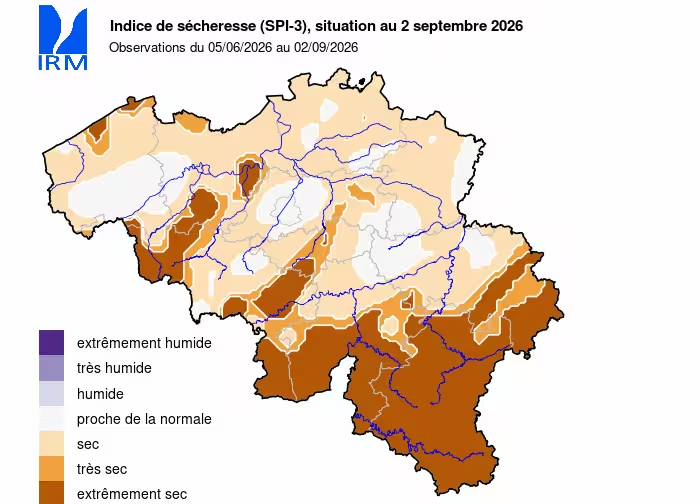
For the summer of 2026, researchers distinguished between two European zones. Belgium belongs to the eastern zone alongside the Netherlands, Denmark, Poland, Estonia, and Slovenia. In this zone, the soil moisture deficits observed between January and June 2026 are now eleven times more likely than they would have been without human-induced global warming. Without this warming, such a drought episode would be expected roughly every 165 years. In the current climate, it can occur approximately every 15 years.
The main mechanism identified by the study: it is not primarily a lack of rain that is to blame, but extreme heat, which accelerates evapotranspiration and drains moisture from the soil much faster than before. "Extreme heat is becoming the main driver of droughts on the continent," highlights Sarah Kew, climatologist at the Royal Netherlands Meteorological Institute (KNMI).
The authors specify that current warming is +1.4°C compared to the pre-industrial era. At +2.8°C, the probability of such droughts could double again.
Dry soil: concrete impacts on your industrial and real estate sites
Soil drought is not just an agricultural or ecological issue. For those behind industrial and real estate projects, it raises very concrete technical questions.
Foundations and underground infrastructure.
Clay, which is widely present in Belgian subsoils, shrinks as it dries. This shrinkage can cause differential settlement: shallow foundations, floor slabs, pipes, and underground tanks may be subjected to stresses not accounted for in geotechnical studies conducted under different climatic conditions. Industrial construction or expansion projects must incorporate this parameter from the feasibility phase.
Groundwater tables and characterization studies.
Prolonged drought lowers groundwater levels. For soil and groundwater pollution characterization studies, this alters sampling conditions: samples taken during low-water periods provide a different picture of the situation than those taken during high-water periods. Incorporating climate variability into the interpretation of results is now a requirement for any soil study conducted in Wallonia, Brussels, or Flanders.
Potentially polluted sites and sites undergoing remediation.
The mobility of pollutants in soil and groundwater depends on soil moisture and the depth of the water table. Very dry soil may retain certain pollutants differently, while a low water table can concentrate contaminants in a smaller area. For site managers overseeing sites under monitoring or remediation, climate change is a parameter that must be integrated into risk models and assessment reports.
On-site water management.
Stormwater retention and infiltration, and the management of impervious surfaces are already standard topics in environmental permit applications. They are taking on new significance with more frequent drought cycles. Paradoxically, very dry soil absorbs heavy rain less effectively and promotes runoff, increasing the risk of local flooding during storms. Designing water management systems that account for this alternation is now a best practice that is gradually becoming standard in project applications.
What regulators are saying (and what is on the horizon)
The WWA study highlights a regulatory gap: no drought management plan is currently mandatory at the European Union level. Member States show highly uneven levels of preparedness.
In Wallonia, flood risk management tools have been strengthened since the floods of July 2021: the SPW urban planning guides for flood-prone areas have been reinforced, and there is a greater focus on Nature-based Solutions (NbS). Vulnerability to drought remains less formalized in currentenvironmental impact assessment (EIA).
The underlying regulatory momentum is clear, however. The CSRD (Corporate Sustainability Reporting Directive), the EU Taxonomy and the DNSH (Do No Significant Harm) criteria now incorporate physical climate risks, including drought and water stress. Companies subject to ESG reporting must document their exposure to these risks. Furthermore, developers of major projects subject to Environmental Impact Assessments (EIA) are increasingly seeing these issues included in admissibility requirements.
What this means for you
Whether you manage an industrial site, are developing a real estate project, or are in the process of applying for an environmental permit, the drought of summer 2026 raises questions that will not disappear come autumn.
Do your soil and groundwater studies account for long-term climate variability? Does your permit application factor in water management during prolonged drought conditions? Does your ESG reporting cover physical climate risks at your sites? Are your construction or expansion projects designed for subsoils with changing hydrological behavior?
ABV Environment supports companies and project developers with all these issues: climate vulnerability studies, soil and groundwater management, environmental impact assessments, and CSRD/VSME reporting. Our teams operate in Wallonia, Brussels, and Flanders.
Is your site prepared for drought? Contact our teams to discuss it.