Companies: measuring, reducing and offsetting CO2 emissions

Measuring, reducing and offsetting CO emissions2 of its activity
ABV Development guides you on the path to carbon neutrality and the decarbonization of your activities, helping you measure, reduce and offset the emissions inherent to your operation.
In order to limit the impacts of climate change, one of the main challenges lies in particular in the drastic reduction of CO2. In this respect, the European Union has set ambitious goals, aiming at carbon neutrality by 2050. The challenge is significant and, in perspective, offers a multitude of development and innovation opportunities for the company.
Reducing your carbon footprint, a responsible commitment
Some companies in the sector have already committed themselves to carbon neutrality. ” This dynamic is increasing and will continue to increase in the few years to come as businesses and other public organizations will have to report on their CO emissions.2, comment Yannick Masquelier, Founding Partner of ABV Development, a consulting firm specialized in the environmental sector. On the other hand, increasing constraints internal or external to the organization, particularly at the fiscal level, will be imposed on activities that emit greenhouse gases. From now on, organizations have every interest in taking part in a process of reducing their carbon footprint. ”
The CO balance2, first step towards carbon neutrality
Through his department Carbon & Climate Transition, ABV Development helps organizations to understand these challenges. The consulting firm offers a variety of effective and pragmatic services and approaches to help organizations: identify, measure and reduce their CO emissions2 and, where appropriate, compensate them. ” The approach starts with a carbon assessment, carried out on the basis of recognized methods, such as standards ISO14064 and ISO14069, the Carbon Balance® method from ADEME, the HG Protocol, the scale of CO performance2 (for the construction sector), and whose scope will essentially depend on the company's activity and its desire to control it, explain Yannick Masquelier. At this level, we will seek to identify the direct emissions of the organization and its activities and company vehicles (scope 1), such as emissions related to factories, installations, warehouses, offices, heating or vehicles owned by the company, those indirect emissions inherent to the consumption of electricity, heat or steam (scope 2), and other indirect emissions, linked to activities upstream and downstream of the organization's value chain. (purchases, suppliers, subcontractors, the use of finished products for example ( scope 3). ”
Adopt a strategy to reduce your carbon footprint
Once the balance sheet has been established and the main sources of emissions identified, it is then possible to consider a strategy to reduce the carbon footprint, by setting priorities and establishing an action plan. ” The challenge is to minimize as much as possible emissions by considering the various technical, organizational and operational means at our disposal for the maximum decarbonization of the organization's activities, continues the partner at ABV Development. However, in most cases, residual emissions remain. Compensation measures can then be considered to make it possible to:achieve neutrality. ”
Offsetting CO emissions2 residuals
The compensation process is reflected in the implementation of projects that act as carbon sinks, or the development of renewable energy production units, making it possible to reduce the need for energy that emits CO2. ” The compensation process only makes sense if you have undertaken everything necessary to minimize your carbon footprint, insists Yannick Masquelier. In order to help our customers in their compensation process (and avoid launching them into tree planting projects on the other side of the planet), we seek to support projects that have a local, concrete and sustainable impact. Through this specific approach, we provide the expected solutions to our customers who are increasingly demanding in their commitments to the decarbonization of their activity. ”
Analyzing the life cycle of a product
An analysis of the life cycle of a finished product (LCA) which will take into account all environmental impacts, and therefore CO emissions2, of the product and its components, including its transport, storage, storage, packaging, operation, maintenance, recycling and end of life.
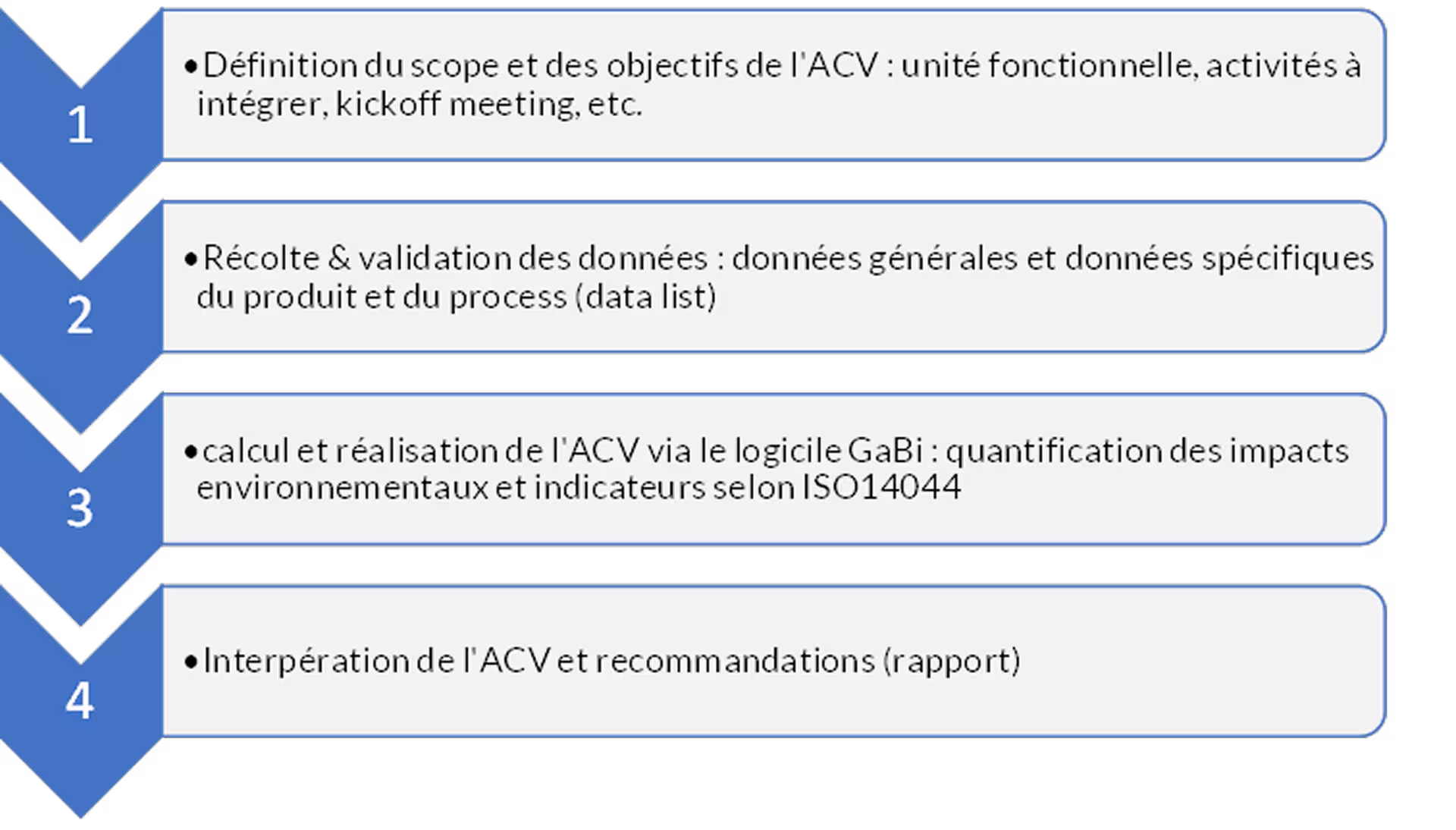
” In the current and especially future context, we can expect the “carbon” impact of a product to be an important selection criterion that is better taken into consideration when choosing a product. as well as the quality and the cost of the latter.”, comments Yannick Masquelier. We are already seeing this for individuals, and more and more for the private sector, especially in Environmental Product Declarations (DEP or EPD in English) of a multitude of finished products. The DEP is a technical document that studies the environmental impact of a product throughout its duration of use. The EPD of a product is the result of a life cycle analysis (LCA) and is used by rating systems, such as the BREEAM for the building. If we go further, the CO cost2 could also affect the price of the product. ” Carrying out a life cycle analysis allows you to have a solid base from which it will be easier to make choices and consider alternatives, for example by preferring local raw materials rather than others imported from more distant countries. ”
The approach, while responding to major environmental challenges for future decades, also supports choices in terms of more sustainable development, contributing to the sound management of its activity.