Tax on machinery and equipment: To what extent will the Walloon government 'course-correct'?

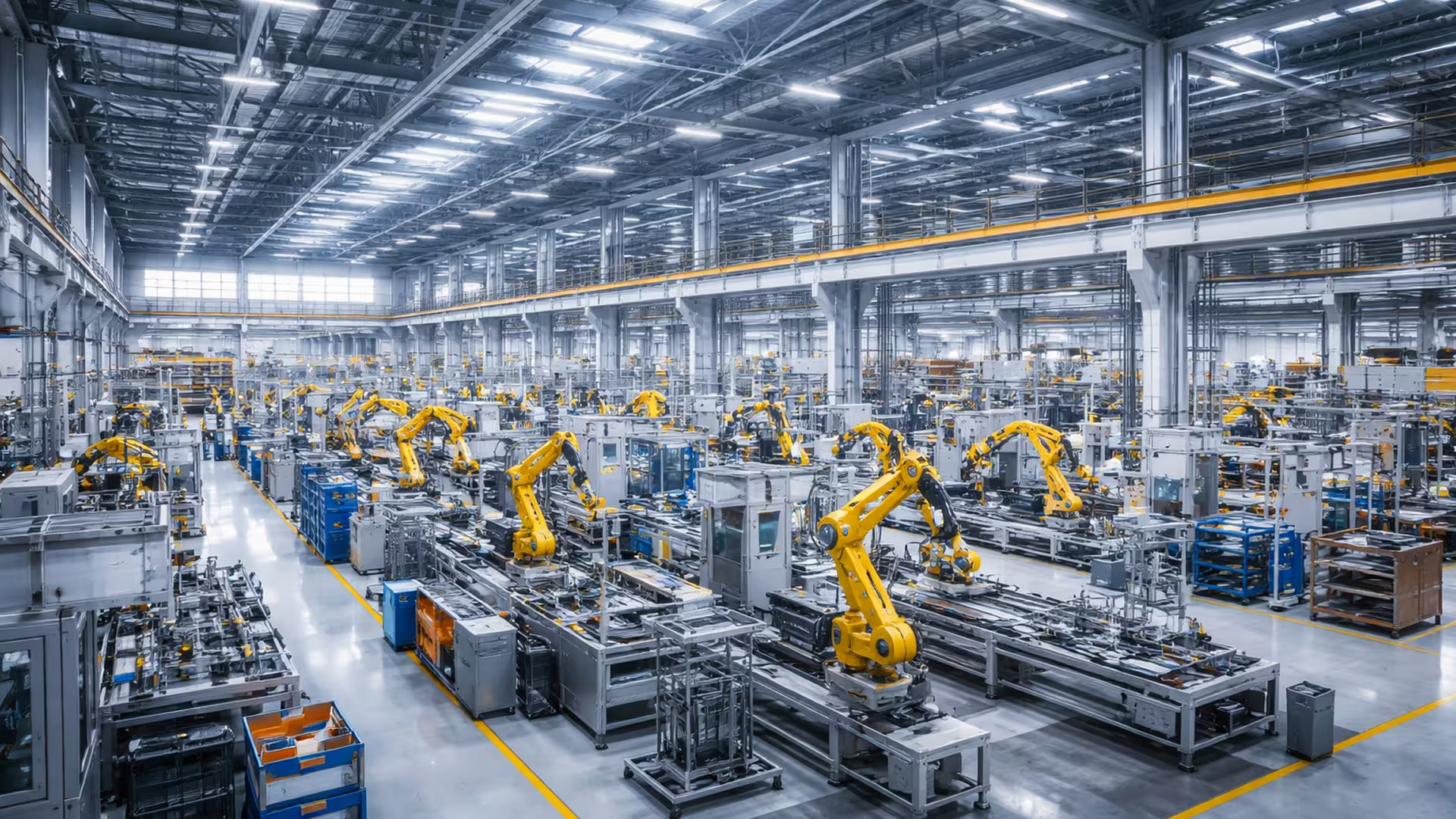
The return of taxation on productive investments in Wallonia — via the tax on driving force and the property tax on equipment and tools — has created a shockwave in the ranks of industrialists.
Some companies refer to a “breach of trust”, others point to a financial blow that was not integrated into their business plan.
A blow from the club
According to our initial estimates, obtained through simulations carried out with our industrial customers, the financial effect risks undermining the competitiveness of companies. “An intermediate-sized company, having invested 100 million euros over fifteen years in the modernization of its site, could see, as early as 2026, an annual charge of between 800,000 and 1 million euros in property tax return. A significant increase, independent of any new investment, which would sustainably increase the fixed costs of the site.”
More generally, “any company subject to property tax on its equipment and tools should notice, as soon as the next tax return, at least a doubling of the portion of withholding tax linked to this equipment”.

Ministers under pressure
Under pressure, the Walloon government hinted a few days ago that it was ready to review the measure. In an interview with L'Echo on 7 February, Economy Minister Pierre-Yves Jeholet (MR) acknowledged that the government had “obviously minimized this impact during the conclave”. He now considers it necessary to “correct the situation in favor of businesses. In a context where we are talking about competitiveness and industrial sovereignty, we cannot leave that as it is.”
Will Wallonia thus, like Flanders, remove equipment and tools from the corporate property tax base?
Where are we going to marginally amend the system in order to avoid a shock wave?
During the debate, the Socialist Party, in opposition in Wallonia, drafted a draft decree that it will soon submit to the Walloon Parliament in order to modify the new regime.
This proposal:
- extends the exemption period for motive power tax from 5 to 10 years;
- adapt the property tax regime on equipment and tools in order to guarantee an exemption of 10 years;
- Exempt investments made on or after 1 January 2016;
- and provides for a retroactive entry into force on January 1, 2026 in order to secure the 2026 fiscal year.
“Concretely, all investments made from 2016 would be exempt for a period of ten years, which makes it possible to avoid the shock and to give companies visibility”, underlines the PS.
What are we talking about?
The reform of the property tax on equipment and tools, adopted by the Walloon Parliament at the end of 2025, provides that all investments in new machines and tools made between 1 January 2006 and 31 December 2020 will be taxed again this year through the property tax. Exemptions for investments made between 2006 and 2020 will be over.
For investments made between January 1, 2021 and December 31, 2025, the decree provides for a dynamic system, with an exemption limited to five years.
Finally, any investment made from 2026 in new tools may also be exempt from withholding tax for five tax years.
In terms of taxation on the driving force, which is the responsibility of municipalities, the reform adopts the same principles in terms of exemption. However, it adds some exceptions for the energy sector, with the exemption of turbines from the tax on motive power.