Why conduct a historical study of a site or plot of land?


As part of a land revaluation project, ABV Development supports you in carrying out the historical study to be carried out.
Why do we need to conduct a historical study of land?
Proceed to a historical study of a land on which a development project is envisaged makes it possible to qualify the risks of pollution, to effectively target the areas where to investigate the soil in order to carry out analyses and to determine the measures to be taken, for example sanitation.
As part of a development project, whether it is a real estate complex or an industrial site, it is common to have to carry out a soil pollution study. This applies in particular in the context of a project to revalorize land that has already been exploited. In order to carry out this analysis successfully, it is necessary to first carry out a historical study of the land.
The historical study traces the activity carried out on a field
” The objective of this approach is to trace the history of the activities to which the planned surface has been allocated., explain Axelle Devos, responsible for historical studies atABV Development, a design office specializing in the environment, security, and land use planning sector. The challenge is to be able to precisely determine the installations and equipment that the site has accommodated over time, to identify the infrastructures that have been installed there, the technologies that have been used and, ultimately, the potential sources of pollution that may have contaminated the soil. ”
Also read - What does a soil pollution study include?
How do you conduct a historical study of land?
In order to carry out a historical study, according to the scope under consideration, ABV Development will consult various data sources and cross-check information in order to trace the evolution of activity that took place on a given site over time.
” The challenge is therefore to go back to the first assignment of a site, to the time when there was still only virgin land, to then see how the settlements evolved., explain Axelle Devos. To do this, a set of documents must be collected from a variety of sources. We can mention those that are in the possession of the owner, such as notarial acts or operating authorizations, of the control reports that he has. We also connect with various administrations, as prescribed by the Orientation Study Reference Guide Of the Walloon Region.”
Read also — When should a soil pollution study be carried out?

Conduct a historical study through a wide variety of sources
These sources include municipal archives, the cadastre, the urban planning service or living environment (formerly “environment”) of the Walloon Region, or even certain federal administrations.
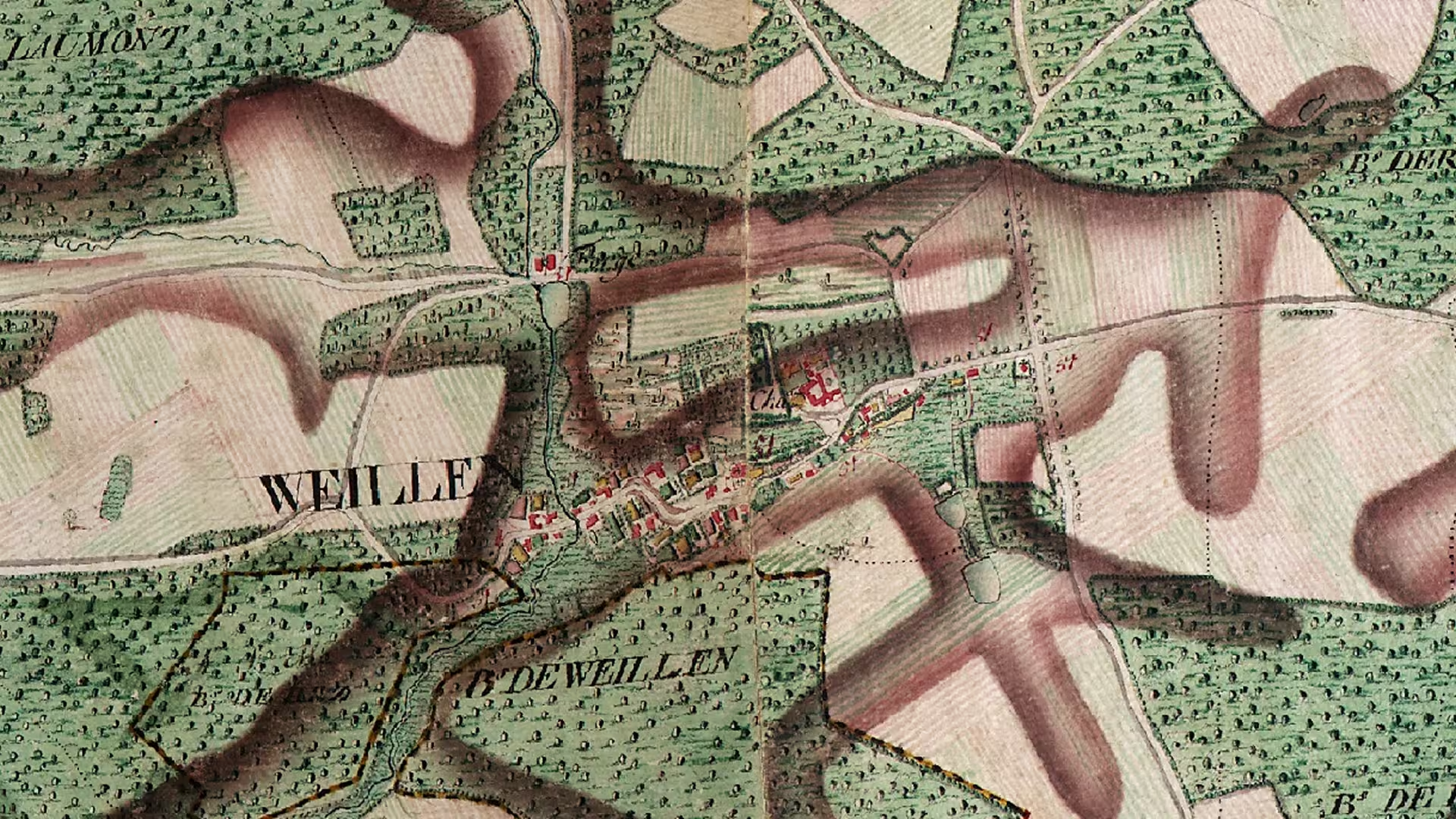
” From the Wallonia Geoportal site, you can go back to the 18thE century by consulting old maps, continues Axelle Devos. This research work can also be based on observations made in the field, through a survey of visible elements on the site, following the visual or olfactory perception of pollution, via the collection of oral testimonies of former employees or even local residents... All this research will have to be documented. ”
Also read - The importance of doing a soil study before building a building
For each plot concerned, an expert must therefore carry out historical work, seeking to trace as precisely as possible the evolution of activities on the site and list the incidents that may have occurred there.
“Over a few decades, an industrial site can change considerably, depending on the investments that have been made there., insure Axelle Devos. Some of the complex files we have had to deal with, linked to ancient coal mines or to important historic industrial sites for example, have resulted in an in-depth investigation of an impressive quantity of archives.”
Gather documents and deliver an interpretation
The objective of this historical research is to consolidate all the elements in a file. If significant time gaps could not be filled, the expert is required to highlight and justify them.
“In addition to compiling the documentary file, the expert is invited to provide an interpretation of the data and to assess the relevance of the information collected., explain Axelle Devos. Based on the historical activities identified, the risks of soil contamination can be determined. By considering the plans at our disposal, by superimposing them according to the history of the site, we can also better objectify the risks and determine the specific places where to drill to carry out analyses.”
The whole results in a synthesis that is at the heart of the orientation study.
Sanitize or not, depending on the historical origin of the pollution
The approach also makes it possible, when pollution is identified, to determine whether it is historical (in other words generated before 30.04.2007) or new (generated after this date). Depending on, it will be possible to justify the need to carry out a soil remediation project or not.
“Indeed, in the case of historical pollution, if the expert determines that this pollution does not constitute a serious threat (i.e. an absence of risks for human health or the environment), there is no need to clean up”, explain Axelle Devos.