Investing with climate risk in mind

Increasingly, regulations and the growing importance of corporate social responsibility are leading us to better assess the impact of any project on the environment (impact of the project on the environment).
Most of the missions ofABV Environment are part of this approach. Another major challenge is to integrate climate change among the risks associated with any investment or any industrial or other activity (impact of the climate on activity/project). To this end, our design office produces climate impact studies (EIC) relating to your investment and development projects.
” Today, investing in large-scale projects requires taking into account climate aspects and their evolution in future years., explains Yannick Masquelier, partner at ABV Development. The intensification of bad weather and floods, the recurrence of drought phenomena are, for example, consequences of global warming that have an impact on an activity or a project. ”
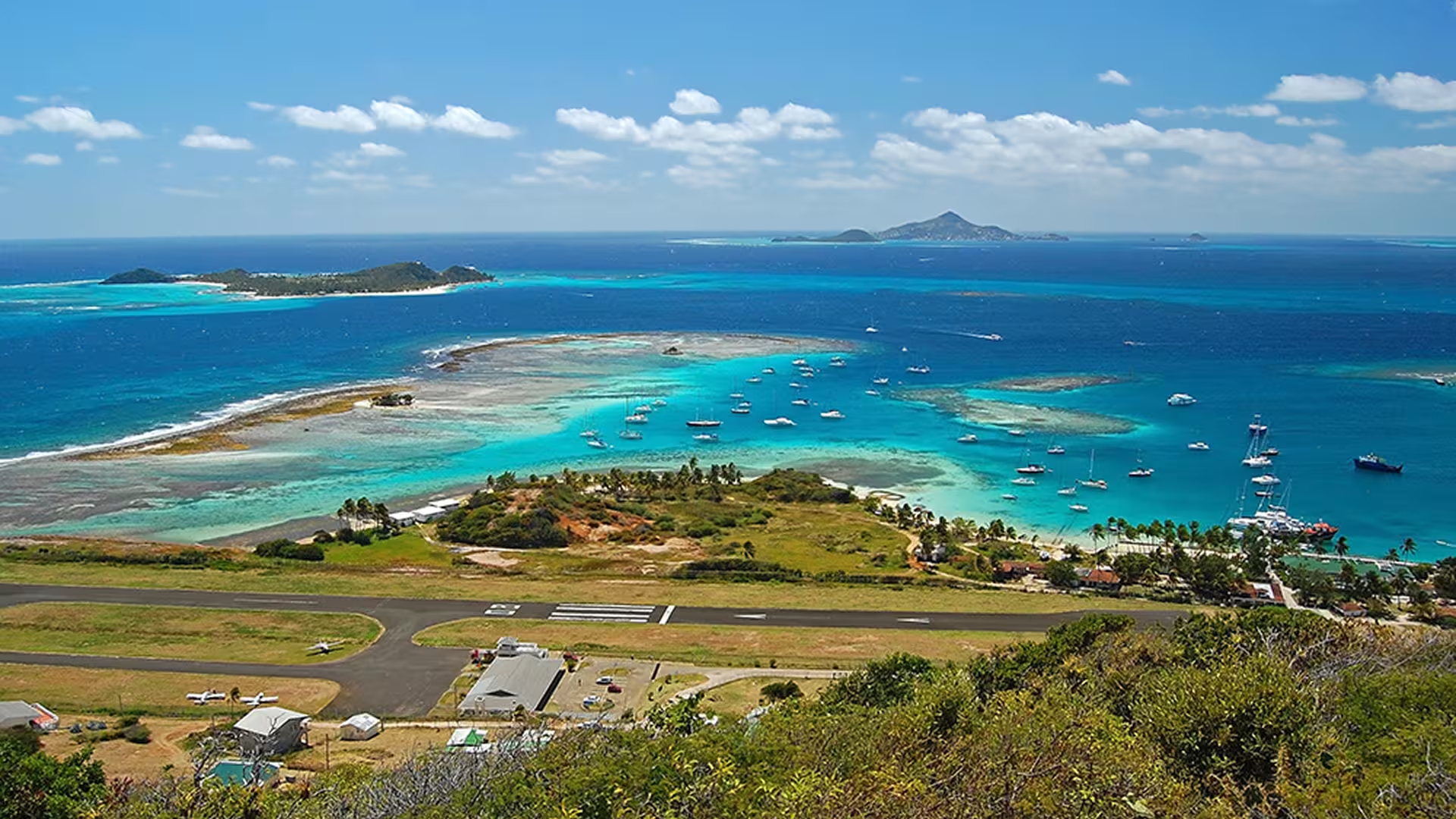
Support the extension of an airport on Reunion Island
In recent years, the ABV Development design office has developed expertise in climate impact studies (EIC) and more particularly in the study of adaptation and mitigation to climate change. These missions are carried out in partnership with the environmental consulting firm ATRIA based in Lille. In particular, the Belgian group intervened in this field on two projects on Reunion Island.
The first concerned the extension and restructuring of the infrastructures ofReunion Roland Garros Airport (ARRG). The second concerned the establishment of a center for the grouping and recovery of household waste with energy recovery on the seafront.
” Our intervention aimed to assess risks and vulnerability to climate change over a time horizon of 50 to 100 years. It is essential to take into account the occurrence of a storm or hurricane, for example, as the region is very exposed, an earthquake or a volcanic eruption., continues the ABV partner. The study, which considers the evolution of risks over 50 to 100 years, allows the project to be developed accordingly. In this way, our customers can guarantee the maintenance of operational activity sustainably, and ensure the preservation of infrastructures over the long term. ”
Studies established on recognized exposure factors
Les climate impact studies (EIC) are based on specific evolution criteria and take into account the geographical context. ” Models exist and exposure factors have been established. We use the latest references and knowledge as well as European guidelines in this field to establish projections over relatively long periods of time., specifies Yannick Masquelier. In Belgium, it is the climatic hazards linked to flooding phenomena (coastal and fluvial), to the increase in the frequency of heat waves, to the increase in extreme rainfall, to the decrease in the availability of groundwater (catchment, agricultural well), to the instability of the soil, to the instability of the soil and to the increase in the intensity of winds during storms that will have to be taken more into account..”
Adapting projects according to climate risks
Depending on the results, the studied project can be reoriented. For example, consideration will be given to strengthening the facilities to deal with more recurrent and more intense storms. In other cases, the EIC will invite the construction of larger storm basins, so as not to be exposed to water damage in the event of severe weather. Heat waves and droughts can also have a significant impact on an activity, on the evolution of soil quality or on the impact on infrastructure. The climate impact study makes it possible to take into account a multitude of situations.
Ensuring the relevance and sustainability of investments
” Today, such approaches are systematically considered in the context of major public infrastructure projects developed via ERDF or EIB funds. For other projects, however, these procedures are not yet mandatory but highly recommended, especially for our private customers, if they are considering major investments in areas “at risk of climate change”., continues Yannick Masquelier. “Understanding climate risk well makes it possible to guarantee, at the heart of a global approach, the relevance and sustainability of investments..”